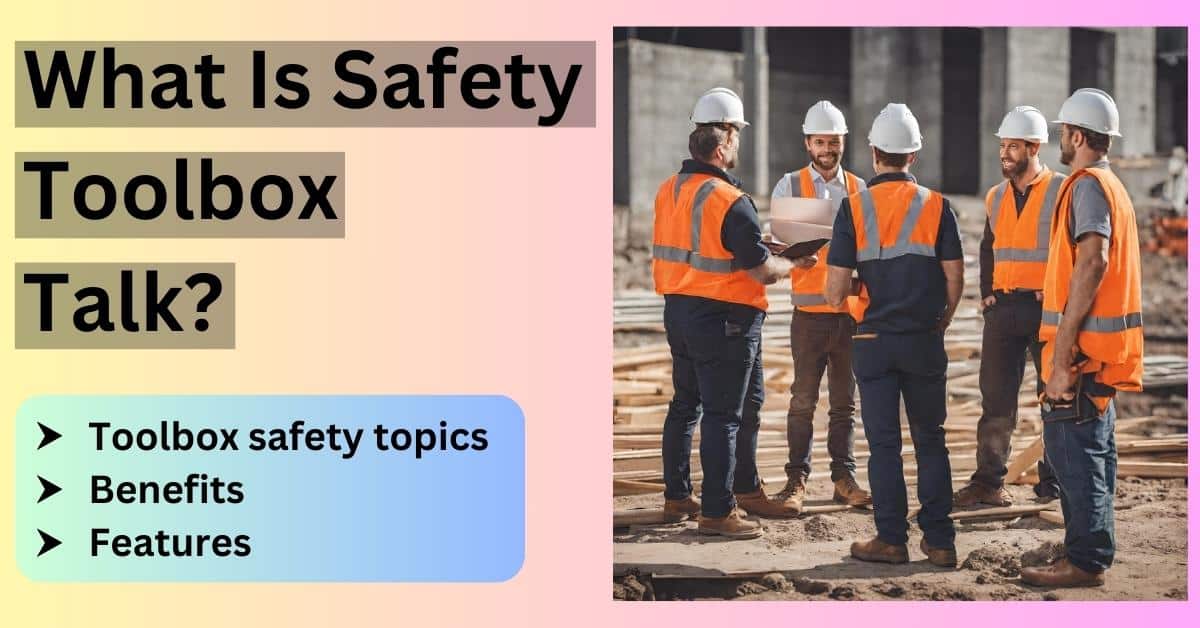
Workers gather in a semi-circle, hard hats on, clipboards in hand. The site supervisor pulls out a crumpled sheet of paper—handwritten notes, crossed-out points, incomplete sign-offs. This isn’t just disorganised—it’s a compliance risk. In the UK construction and industrial sectors, a well-structured toolbox talk template isn’t a nice-to-have. It’s a frontline defence against accidents, a legal safeguard, and a tool for building a culture of safety.
Yet many teams still rely on inconsistent formats, missing documentation, or ad-hoc discussions that leave no audit trail. The stakes are high: under the Management of Health and Safety at Work Regulations 1999, employers must conduct suitable risk assessments and communicate hazards effectively. Toolbox talks—when properly documented—are central to that duty.
This guide cuts through the noise. You’ll get legally grounded, field-tested templates, common failures to avoid, and how to use them in real-world scenarios—specifically for UK operations.
What Is a Toolbox Talk and Why the Template Matters
A toolbox talk is a short, focused safety meeting—typically 10 to 15 minutes—held at the worksite. It addresses immediate hazards, new tasks, equipment use, or recent incidents. The goal? To reinforce awareness, clarify procedures, and ensure everyone leaves understanding the risks.
But a talk without a structured template is like a risk assessment without a signature—technically done, but legally weak.
UK regulators, including the Health and Safety Executive (HSE), expect documented evidence of safety communication. A consistent template ensures:
- Key topics aren’t missed
- Attendees are recorded
- Discussions are traceable in audits or incident investigations
- Workers confirm understanding (via sign-off)
Without a template, you risk inconsistent messaging, poor recall, and non-compliance during HSE inspections.
Core Elements of a UK-Compliant Toolbox Talk Template
Not all templates are equal. A strong UK-focused format includes these non-negotiable sections:
#### 1. Topic & Date Clearly define the subject—e.g., “Working at Height – Scaffolding Safety”—and the date of the talk. This helps link discussions to specific tasks or weather conditions.
#### 2. Site & Project Details Include site name, location, and project reference. Crucial for multi-site contractors or tier-1 subcontractors managing multiple contracts.
#### 3. Lead Presenter Name and role of the person delivering the talk (e.g., Site Manager, SHEQ Officer). Accountability starts here.
#### 4. Attendee List with Signatures Each worker must sign or initial. This proves attendance and understanding. Digital signatures are acceptable if securely stored.
#### 5. Key Hazards Identified List specific risks tied to the task—e.g., “falling objects,” “unsecured edge protection.” Link these to the project’s risk assessment.
#### 6. Control Measures Clearly state actions: “Harnesses must be worn,” “Only trained personnel on MEWPs,” “Tool lanyards required.” Avoid vague language.
#### 7. Questions & Discussion Summary A line or two summarising worker input—e.g., “Concerns raised about ladder access; adjusted platform setup.” Shows engagement.

#### 8. Incident Reference (if applicable) If the talk follows a near-miss or incident, reference the report number. Reinforces learning from real events.
Leave blank fields for “review date” or “next follow-up” to track recurring topics.
Common Mistakes That Undermine Toolbox Talks
Even with a template, teams get it wrong. These errors undercut safety and compliance:
- Repeating the same talk weekly – Workers tune out. Rotate topics monthly and refresh content with seasonal risks (e.g., slips in winter).
- Using generic templates with no site context – A “working at height” talk for a warehouse racking system differs from one on a high-rise scaffold. Tailor content.
- Poor attendance tracking – Missing signatures? Unexcused absences? This breaks the audit chain. Follow up with absentees individually.
- No follow-up or reinforcement – A talk ends, but unsafe behaviours continue. Supervisors must observe and correct in real time.
- Storing paper copies in a damp site office – Lost, damaged, or illegible records have no legal value. Scan and back up digitally.
One contractor faced HSE enforcement after a fall incident revealed toolbox talk sign-in sheets were missing for three weeks. The excuse? “We did the talks, just forgot to write it down.” Not acceptable.
Free Toolbox Talk Template Examples (UK Format)
Below are adaptable, real-world template structures—ready for daily use on UK sites.
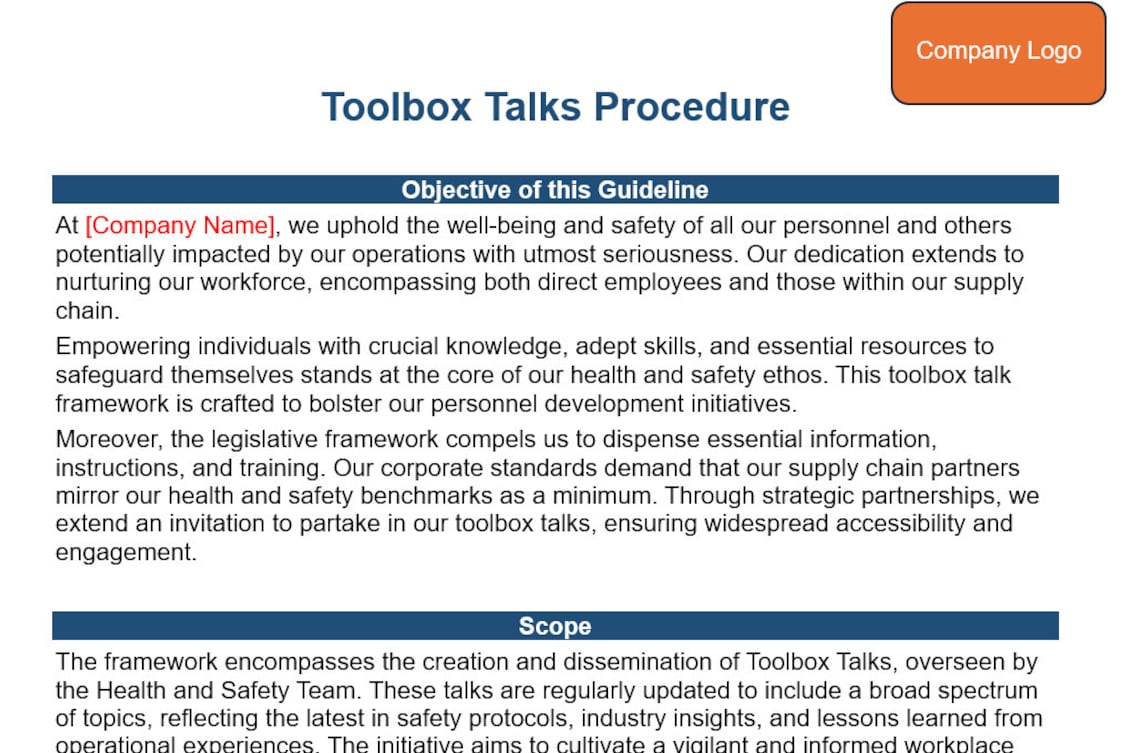
#### Basic Printable Template (PDF/Word) Ideal for small contractors or manual record-keeping. Includes: - Header with company logo - Topic, date, site name - Attendee signature block (15 lines) - 5-point hazard and control section - Presenter and reviewer fields
Best for: Groundworks, roofing, electrical teams needing simple paper trails.
#### Digital Form (Google Forms or MS Forms) Automated version with dropdowns for topics and roles. Features: - Auto-timestamp and geotag (via mobile) - Email confirmation to HSE lead - Export to Excel for monthly reporting
Best for: Large sites with rotating shifts or remote supervisors.
#### Multilingual Template With translated hazard descriptions (e.g., Polish, Romanian, Urdu) alongside English. Critical where language barriers exist. Includes pictograms for universal understanding.
Best for: Labour-intensive sites with diverse teams.
#### Task-Specific Templates Pre-built for common UK risks: - Excavation & buried services - Manual handling of building materials - Hot works (welding, grinding) - Confined space entry
Each aligns with HSE guidance like HSG140 (Excavation) or HSG107 (Confined Spaces).
#### Incident-Led Template Triggered after a near-miss or injury. Structured to: - Describe the event - Identify root causes - Confirm updated controls - Require re-training sign-off
Use case: After a dropped tool incident, this template ensures all高空作业 teams review tool lanyards and double-check PPE.
Integrating Templates into Your Safety Workflow
A template isn’t a one-off form. It’s part of a live safety system. Here’s how to embed it effectively:

1. Schedule talks weekly or per task phase Align with method statements. For example, before starting bricklaying, conduct a talk on material handling and edge protection.
2. Train supervisors to deliver—not read The best talks are interactive. Encourage questions like, “What would you do if the guardrail was missing?” rather than reciting bullet points.
3. Link to risk assessments and permits Reference the relevant document—e.g., “As per RA-2024-087, Section 3.2”—to create a cohesive safety framework.
4. Store and review records monthly Audit past talks to spot recurring issues. If “slips on wet surfaces” appears three months in a row, it’s time for better drainage or anti-slip mats.
5. Use data to improve training If multiple talks highlight confusion over PPE, schedule a refresher course.
One civil engineering firm reduced incidents by 40% in six months simply by analysing their toolbox talk logs and targeting weak areas.
Where to Source Reliable UK Templates
You don’t need to build from scratch. Trusted sources offer compliant, editable formats:
- HSE Website (hse.gov.uk)
- Free guidance and example formats under “Toolbox talks” in the construction section. Not templates per se, but excellent reference content.
- Construction Industry Training Board (CITB)
- Offers safety talk resources, including downloadable templates and facilitator guides. Some require a subscription.
- NEBOSH and IOSH
- Members get access to safety toolkits with customisable toolbox talk formats. Ideal for safety professionals.
- Contractor Safe Systems (CSS)
- Online platform with pre-built, UK-specific templates. Integrates with digital sign-in and reporting.
- Trade Associations (e.g., UKCG, FMB)
- Provide members with industry-specific templates—e.g., roofing safety talks from the NFRC.
Avoid random blog downloads. Many lack legal grounding or omit critical fields like attendee verification.
Making Toolbox Talks Actually Work on Site
Templates help, but culture drives compliance. The most effective teams do this:
- Start on time, end on time – Respect workers’ time. A 12-minute talk builds trust; a 30-minute lecture invites resentment.
- Rotate presenters – Let experienced operatives lead a session. Increases ownership.
- Use real examples – “Last week in Birmingham, a worker fell from a ladder—here’s how we avoid that.”
- Keep it visual – Show damaged PPE, photos of unsafe setups, or short safety clips on a tablet.
- Follow up – Walk the site after the talk. If someone isn’t wearing gloves after a “handling sharp materials” talk, correct it immediately.
One site manager uses a “safety coin” system: workers who spot hazards mentioned in recent talks get a token redeemable for rewards. Engagement soared.
Toolbox talk templates in the UK aren’t bureaucracy—they’re accountability. The right template keeps your team alert, your records solid, and your site compliant with HSE expectations. Use the formats and strategies above to turn routine meetings into real safety progress. Download, customise, and implement one today—before the next inspection or incident forces the issue.
FAQ
What should you look for in Toolbox Talk Template UK – Free & Compliant Formats? Focus on relevance, practical value, and how well the solution matches real user intent.
Is Toolbox Talk Template UK – Free & Compliant Formats suitable for beginners? That depends on the workflow, but a clear step-by-step approach usually makes it easier to start.
How do you compare options around Toolbox Talk Template UK – Free & Compliant Formats? Compare features, trust signals, limitations, pricing, and ease of implementation.
What mistakes should you avoid? Avoid generic choices, weak validation, and decisions based only on marketing claims.
What is the next best step? Shortlist the most relevant options, validate them quickly, and refine from real-world results.