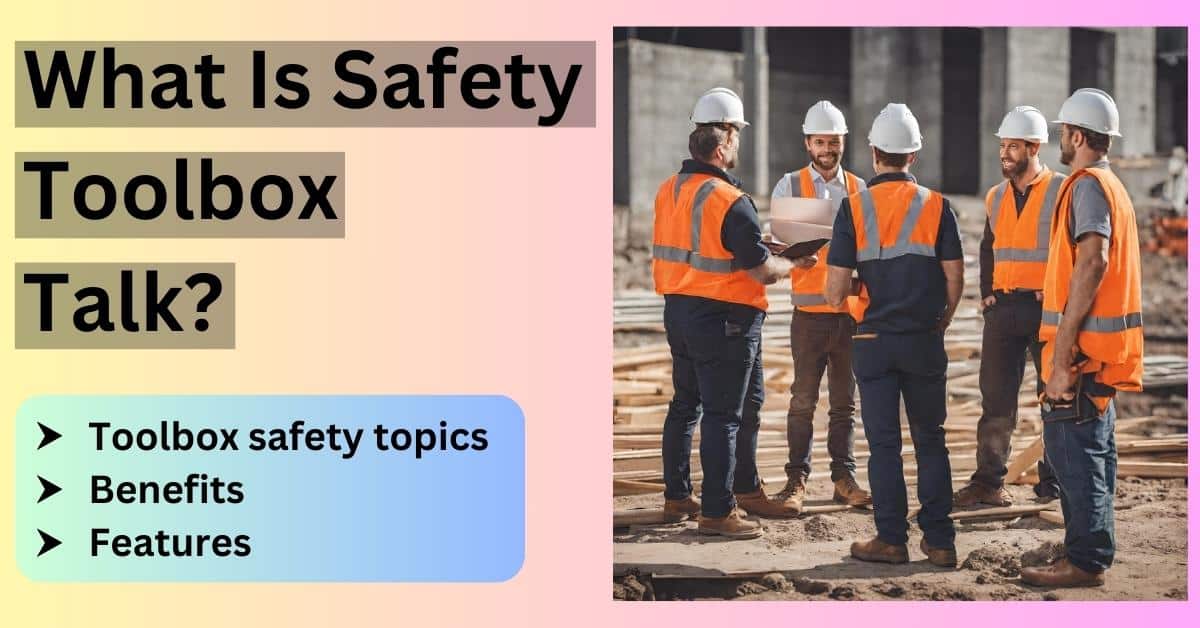
Safety doesn’t start with a policy memo or a laminated poster—it starts with a conversation. And few workplace rituals deliver that conversation as effectively as the toolbox talk. These short, focused safety meetings are the frontline defense against incidents, especially in high-risk environments like construction, manufacturing, and utilities.
Yet, too many teams treat toolbox talks as routine compliance tasks—checked off quickly, remembered poorly, and rarely impactful. The result? Missed opportunities to prevent slips, falls, equipment misuse, and worse.
The real power of a toolbox talk lies in its specificity, relevance, and timing. When the topic hits close to home—when it mirrors what workers are actually doing that day—the message sticks. This article breaks down the most critical toolbox talks safety topics, how to deliver them effectively, and why some common approaches fail.
Why Toolbox Talks Matter More Than Ever
Despite advances in PPE, automation, and training platforms, human error remains a leading cause of workplace incidents. OSHA estimates that fall protection, hazard communication, and scaffolding issues consistently top the list of most-cited violations. These aren’t abstract problems—they’re daily realities on job sites.
Toolbox talks bridge the gap between broad safety policies and on-the-ground behavior. A 10-minute discussion before a roofing crew ascends a ladder isn’t just a formality—it’s a chance to reinforce proper harness use, weather conditions, and anchor points.
But relevance is key. Talking about forklift safety to a team of electricians installing conduit isn’t just ineffective—it erodes trust in the entire safety process.
The bottom line: Effective toolbox talks are timely, task-specific, and actionable. They answer: What can go wrong today, and how do we stop it?
1. Fall Protection: Still the #1 Risk
Falls remain the leading cause of death in construction. According to the Bureau of Labor Statistics, one in five construction fatalities is due to falls. Yet, fall protection is often treated as a one-size-fits-all solution.
What to cover in your toolbox talk: - Proper inspection of harnesses, lanyards, and anchor points - The 6-foot rule: when fall protection is required (OSHA 1926.501) - Common mistakes: tying off to unstable structures or using damaged equipment - How weather (wind, rain, ice) affects fall risk
Real-world example: A crew installing HVAC units on a flat roof assumed they were safe because the edge wasn’t steep. But a loose cable caused one worker to trip—without fall protection, the result could have been fatal.
Include a quick hands-on demo: Pass around a worn harness and ask the team to identify red flags—frayed webbing, cracked buckles, expired tags.
2. Hazard Communication (HazCom): Understanding the Labels
Workers handle chemicals daily—cleaners, adhesives, solvents, fuels. But how many actually read the labels or understand the pictograms on GHS-compliant containers?
A toolbox talk on HazCom should go beyond “wear gloves.” It should answer: - What do the red diamond, flame, and skull symbols mean? - Where is the SDS (Safety Data Sheet) stored, and how do you access it? - What to do in case of skin contact or inhalation?
Common mistake: Assuming labeling is enough. If a container is transferred to a secondary bottle without proper labeling, the hazard is no longer visible.
Pro tip: Bring a real unlabeled secondary container and ask the team what’s wrong. Then contrast it with a properly labeled one. The visual difference drives the point home.
3. Hand and Power Tool Safety
Tools are extensions of the worker—but they’re also common sources of injury. From kickback on circular saws to frayed cords on drills, overlooked details lead to lacerations, shocks, and amputations.
Critical points to address: - Inspect tools before each use: check cords, guards, and grounding - Never remove safety guards—even “just for a second” - Use the right tool for the job (e.g., no using a screwdriver as a chisel) - Store tools properly to prevent damage and tripping hazards
Use case: A worker used a damaged angle grinder without a guard. The disc shattered, sending metal fragments into his forearm. A five-minute inspection would have caught the cracked guard.
Make it interactive: Have team members demonstrate proper grip, stance, and shutdown procedures.
4. Confined Space Entry: Silent but Deadly
Confined spaces—tanks, vaults, silos—present invisible threats: low oxygen, toxic gases, engulfment. Yet many workers enter them without permits, testing, or rescue plans.
Key discussion points: - Is this space truly “confined”? (Limited entry/exit, not designed for continuous occupancy) - Has the atmosphere been tested with a calibrated gas detector? - Is there a standby attendant? Is rescue equipment on-site? - What’s the emergency procedure if someone collapses?
Limitation: Not all teams have access to gas monitors. In those cases, the talk should emphasize: If you can’t test it, you can’t enter it.
Workflow tip: Use a checklist. Print a simplified confined space entry checklist and walk through it step by step.
5. Electrical Safety: Respect the Current
Electricity doesn’t forgive shortcuts. From overhead power lines to temporary wiring, risks are everywhere.
Must-cover topics: - Minimum approach distances (10 feet for lines under 50kV) - Lockout/Tagout (LOTO) procedures before servicing equipment - Using GFCI outlets on temporary power - Inspecting cords for cuts, splices, or overheating
Real mistake: A worker used a metal ladder near a live panel to replace a light fixture. One slip—and contact—could have been fatal.
Actionable takeaway: Reinforce the “one hand rule” when working near live circuits: keep one hand behind your back to prevent current from crossing the heart.
6. Lifting and Material Handling
Strains and sprains make up nearly 20% of all workplace injuries. Yet lifting is often seen as “just part of the job.”
A toolbox talk should challenge that mindset. Focus on: - Proper lifting technique: bend knees, keep back straight, no twisting - When to use mechanical aids (dollies, hoists, forklifts) - Team lifts: communication and coordination - Housekeeping: cluttered walkways increase strain risk
Example: A plumber lifted a 75-pound pump alone, twisting mid-lift. Result: a herniated disc and six weeks off work.
Practical drill: Have two workers demonstrate a correct team lift with clear verbal cues.
7. Personal Protective Equipment (PPE): Right Gear, Right Time
PPE only works if it’s worn correctly—and consistently.

This talk should go beyond “wear your helmet.” It should address: - When to replace PPE (cracked hard hats, scratched face shields) - Proper fit (gloves too large reduce dexterity; too small tear easily) - Limitations of PPE (gloves don’t make you immune to cuts) - Hygiene: cleaning reusable respirators, storing gear properly
Common failure: Workers wear safety glasses but remove them to wipe sweat—then get hit with debris.
Tip: Do a “PPE audit” during the talk—ask each person to check their own gear for damage.
8. Situational Awareness: See It Before It Happens
Many incidents occur because workers are distracted, rushed, or complacent.
A toolbox talk on situational awareness encourages workers to: - Scan the area before starting work - Identify moving vehicles, overhead work, or changing conditions - Speak up when something feels unsafe - Avoid “tunnel vision” during repetitive tasks
Use case: A laborer was walking backward with a wheelbarrow and didn’t see a drop-off behind him. A spotter could have prevented the fall.
Exercise: Ask the team to describe three potential hazards in their current work zone. This builds observation habits.
9. Emergency Response: Know What to Do
When seconds count, hesitation costs lives.
Review: - Location of first aid kits, AEDs, fire extinguishers - Emergency shutdown procedures - How to report an incident (who to call, what info to give) - Evacuation routes and assembly points
Critical gap: Many workers don’t know who the site safety officer is. Name them. Write it down.
Drill idea: Run a 60-second “what if” scenario: “What if someone collapses? Who calls 911? Who gets the AED?”
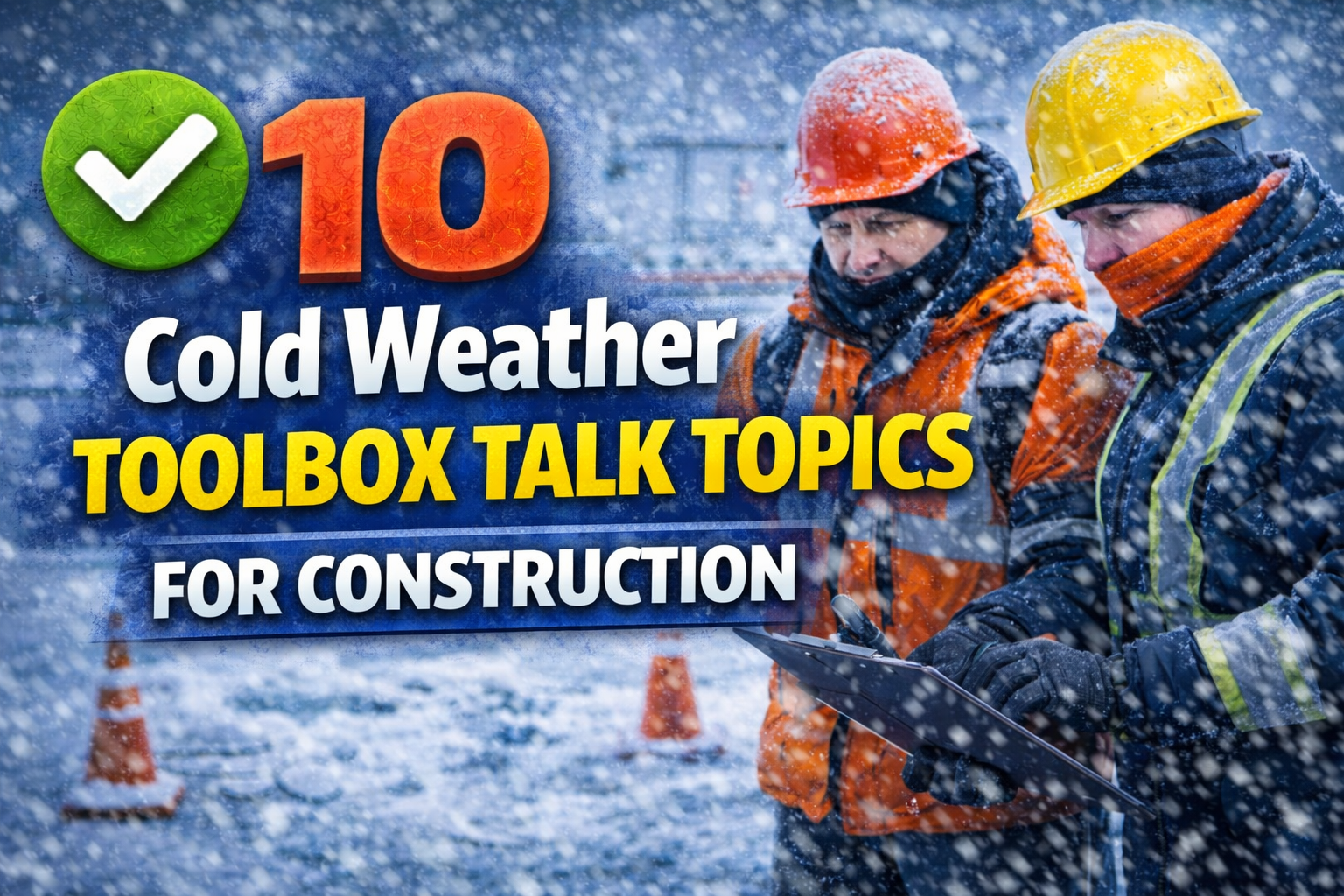
10. Weather-Related Hazards: Heat, Cold, and Storms
Environmental conditions change risk levels fast.
Heat stress talk points: - Signs of heat exhaustion: dizziness, nausea, heavy sweating - Hydration: drink water every 15–20 minutes, even if not thirsty - Use of shade, cooling vests, and work/rest cycles
Cold weather focus: - Wind chill effects - Layering clothing - Recognizing frostbite and hypothermia
Storm prep: - When to stop work (lightning, high winds) - Securing tools and materials - Shelter locations
Real incident: A worker ignored early signs of heat illness and collapsed. He missed two weeks of work—and the crew lost momentum.
Action: Post a heat index chart at the site trailer and review it daily during summer.
How to Run Better Toolbox Talks
A great topic fails if the delivery is poor. Avoid these pitfalls: - Monologue mode: Don’t lecture. Ask questions. Get input. - Irrelevance: Match the talk to the day’s tasks. - No follow-up: If a hazard is identified, act on it.
Best practices: - Keep it under 15 minutes - Use visuals: photos, real tools, diagrams - Rotate facilitators—give junior workers a chance to lead - Document attendance and topic (required for OSHA compliance)
Effective toolbox talks don’t just check a box—they change behavior. Pick the right topic, make it real, and make it interactive. Do that consistently, and you’re not just running a safety meeting—you’re building a safer culture.
For tomorrow’s job, choose one high-risk task. Build a 10-minute talk around it. Engage the team. Watch the difference it makes.
FAQ
What should you look for in Top Toolbox Talks Safety Topics for Safer Workplaces? Focus on relevance, practical value, and how well the solution matches real user intent.
Is Top Toolbox Talks Safety Topics for Safer Workplaces suitable for beginners? That depends on the workflow, but a clear step-by-step approach usually makes it easier to start.
How do you compare options around Top Toolbox Talks Safety Topics for Safer Workplaces? Compare features, trust signals, limitations, pricing, and ease of implementation.
What mistakes should you avoid? Avoid generic choices, weak validation, and decisions based only on marketing claims.
What is the next best step? Shortlist the most relevant options, validate them quickly, and refine from real-world results.